
What is Prosecco?
Prosecco explained for US drinkers: the Glera grape, the hills and plains of northeast Italy, the tank method, the law, and how to choose a bottle.
The short answer. Prosecco is a sparkling wine from a protected corner of northeast Italy, made mostly from a white grape called Glera. Most of it gets its bubbles in a large steel tank, which keeps it light and fresh, with green apple, pear and white flowers. Only wine from that region, made under its rules, can be called Prosecco.
Prosecco has an image problem, and it's a flattering one. Americans order it as "the cheaper Champagne," the bottle you open when the occasion is nice but not that nice. Then they judge it by Champagne's rules: is it toasty, is it complex, is it worth saving? It isn't trying to be any of those things. Prosecco isn't cheap Champagne. It's a different idea, and a cheerier one.
It's a place, not a grape
The name comes from a village called Prosecco, in the hills above Trieste, a few miles from the Slovenian border. Wine from there was written about in the late 1600s, and over the next two centuries the vines spread west into the Veneto. Today Prosecco comes from nine provinces across the Veneto and Friuli Venezia Giulia, and nowhere else.
For most of its history the grape was called Prosecco too. In 2009 Italy renamed it Glera, an old local name, so that "Prosecco" would be a place only. That was the smart move. A place name can be protected, the way Champagne is. A grape name can't, because anyone anywhere can plant a vine.
Glera has to be at least 85% of the wine. The rest can come from a short list that includes a few old local grapes (Verdiso, Bianchetta, Perera) and some familiar ones (Chardonnay, Pinot Bianco, Pinot Grigio, Pinot Nero). Most of what you'll drink is close to pure Glera.
The bubbles come from a tank
Champagne makes its bubbles in the very bottle you buy, slowly, which is where its toasty, bready notes come from. Most Prosecco does that second fermentation in a big sealed steel tank. The gas has nowhere to go but into the wine, which is then filtered and bottled under pressure. Italians call it the Martinotti method. Americans usually hear "Charmat," after the Frenchman who refined it.
It's faster and less expensive, which is part of why Prosecco usually costs less than Champagne. But it isn't a shortcut. Short contact with the yeast is exactly what keeps Glera's fruit and flowers up front. You don't buy Prosecco to taste the cellar. You buy it to taste the orchard. (The whole process, step by step, is in how Prosecco is made.)
Most Prosecco in the US is spumante, fully sparkling. You'll also see frizzante, which is gently fizzy, a little like the difference between a glass of seltzer and one that's been open since lunch, only on purpose.
The words on the label
Three are worth knowing before you shop.
DOC or DOCG. Both tell you where the grapes grew and which rules the wine follows. Prosecco DOC is the large zone, plains and hills, and it's most of what's on American shelves: the Consorzio counted 667 million bottles in 2025. The two DOCGs are smaller hill zones in the province of Treviso, with stricter rules. Neither word tells you how the wine will taste. The difference gets its own page: DOC vs DOCG.
Brut or Extra Dry. This is the sweetness word, and it runs backwards. Brut is dry. Extra Dry is a little sweet. We have opinions about whoever designed this, and they're all in Is Prosecco sweet?
Rosé. Pink Prosecco has been legal only since 2020. Prosecco DOC Rosé is Glera with 10% to 15% Pinot Nero, and it always shows a vintage year. If a pink bottle says Prosecco DOC Rosé and a year, it's the real thing. More in Prosecco Rosé.
The one thing to remember
Drink it young and drink it cold. Prosecco is made to be fresh, so the bottle you've been saving for a special occasion is getting less special every month. Pour it into a white wine glass rather than a skinny flute, so you can actually smell what you paid for. More in how to serve Prosecco, and every word in this post is in the glossary.
Want the full story? Read the complete guide on prosecco.com: What is Prosecco? A guide to Italy's sparkling wine.
Our own wine
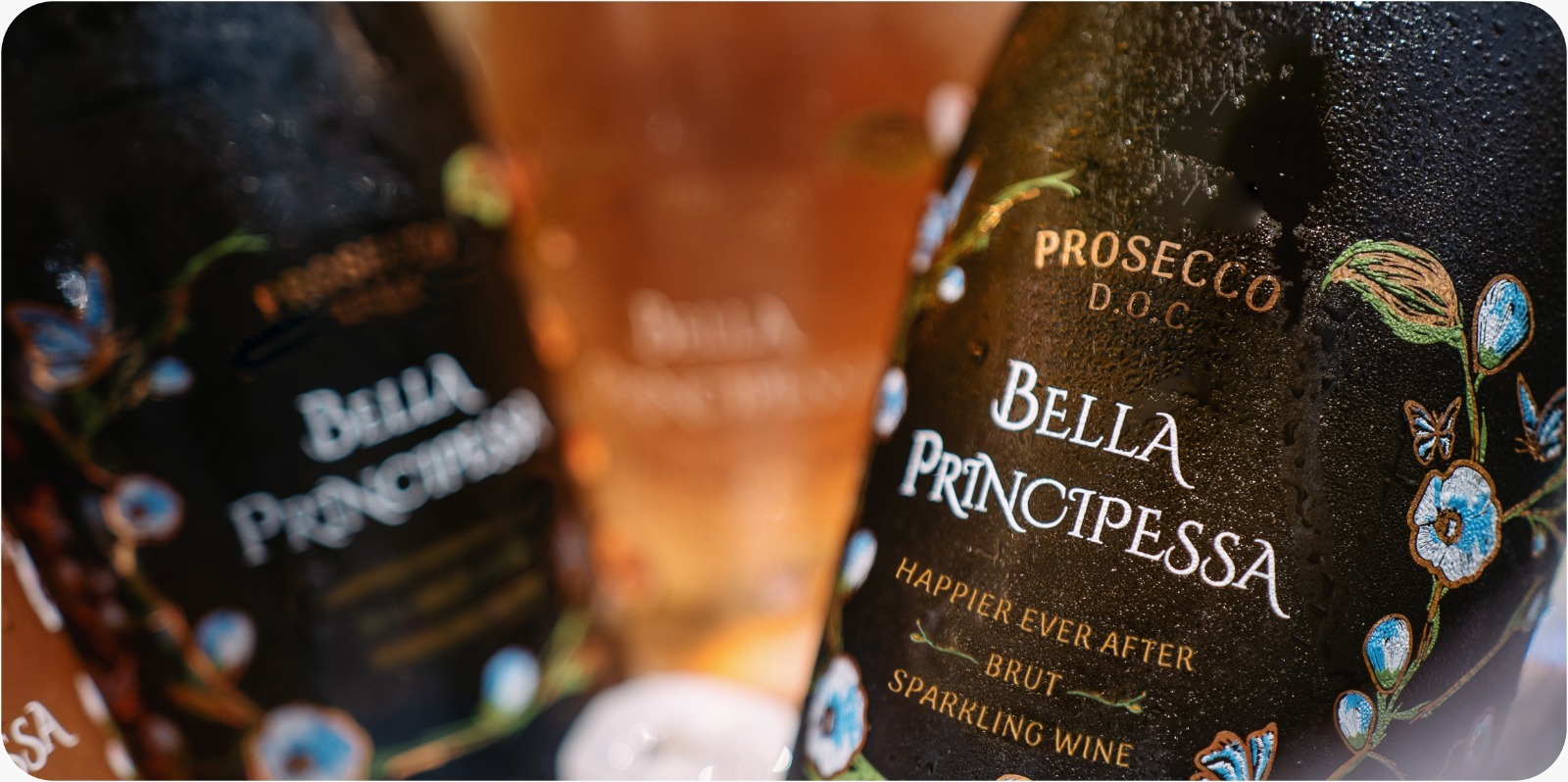
Bella Principessa Prosecco
Bella Principessa Prosecco DOC and Bella Principessa Prosecco DOC Rosé, both Brut, in a hand-painted bottle. Made by the team behind this site.
Meet Bella Principessa Where to buy Prosecco in the USQuick answers
Is Prosecco a grape or a place? A place. The grape is Glera, renamed in 2009 so that only the region can use the word Prosecco.
Is Prosecco the same as Champagne? No. It's a different grape from a different region, and most Prosecco gets its bubbles in a tank rather than in the bottle, which keeps it lighter and fruitier.
What's the difference between spumante and frizzante? Spumante is fully sparkling. Frizzante is gently sparkling. Most Prosecco sold in the US is spumante.
Is pink Prosecco real Prosecco? Yes, since 2020. Prosecco DOC Rosé is Glera with 10% to 15% Pinot Nero, and it always shows a vintage.
Sources
- Consorzio Prosecco DOC: the DOC and its production rules, 2025 bottle figures
- Production regulations, Conegliano Valdobbiadene Prosecco DOCG
- Disciplinare, Asolo Prosecco DOCG
- Commission Delegated Regulation (EU) 2019/33, Annex III (sweetness terms)
- Wikipedia: Glera) (the 2009 renaming)
Last checked: October 2026
The Prosecco Desk: the Proseccotists behind Bella Principessa Prosecco. We love this region and write about it plainly. No producer pays to be mentioned.
Featured Prosecco

Bella Principessa Prosecco
Best Prosecco Rosé

Bella Principessa Prosecco
Best Prosecco DOC

Signorina Prosecco
Write a comment
Post a Comment